
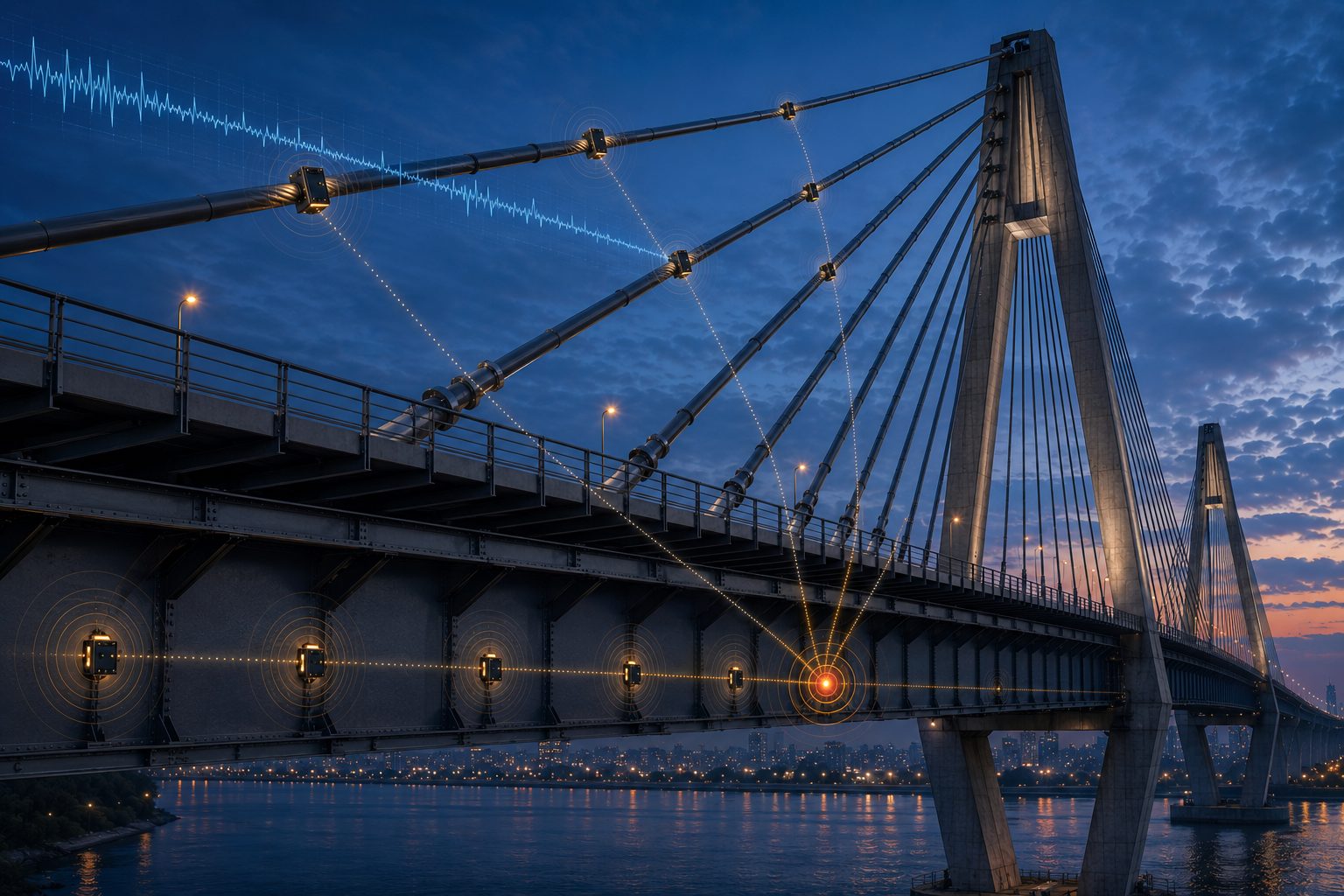
Bridges are constantly communicating. Most of what they send out is routine — but when a crack begins to grow or a prestressing wire suddenly snaps, the structure signals a different kind of event.
When a wire snaps or a crack forms and extends in Fracture Critical Members (FCMs) or pre- or post-tensioned members, the engineer must face the harsh reality of determining the root cause, the extent of the issue, and a path forward — often across an inventory of thousands of bridges, where deciding when to act and how to direct limited resources is its own challenge.
Acoustic Emission (AE) monitoring changes that. By continuously “listening” to the high-frequency stress waves released when damage occurs, AE monitoring gives bridge owners and engineers real-time insight into the health of critical structural components. Rather than relying solely on periodic inspections to discover what has already happened, engineers can identify active damage as it develops, prioritize repairs based on actual structural behavior, and make more informed decisions about maintenance and rehabilitation.
For agencies responsible for managing thousands of aging bridges with limited budgets, this shift from reactive inspections to proactive monitoring can improve safety, extend service life, and help direct resources where they are needed most.
What is Acoustic Emission Monitoring?
Acoustic Emission refers to the high-frequency stress waves released when a material experiences changes such as crack formation and growth, tendon ruptures, or fiber breakage in composites. Sensitive sensors attached to the structure “listen” for these waves in real time, picking up activity long before structural issues would be visible to the naked eye or detectable through periodic visual inspection.
Sophisticated algorithms then filter out background noise, flag the high-intensity events most likely to signal real damage, and pinpoint the probable source using the tiny differences in which each sensor detects the same wave (a concept known as Time Difference of Arrival, or TDOA).

Applications for Bridges
Stay cables and post-tensioning tendons: Corrosion, fatigue, or manufacturing defects can cause individual wires to fail one at a time long before the cable or tendon as a whole is at risk, but each break is a meaningful warning sign that needs to be tracked.
Because these wires are often sealed inside cable sheathing, grout, or concrete, there is no way to visually inspect them without disruptive and costly intervention. AE sensors placed at anchorages or along the cable detect the distinct acoustic signature of a wire fracture the instant it happens, including:
- Identifying which cable or tendon experienced the break
- Estimating the approximate location of the failure along its length
- Tracking the cumulative number of breaks over time to assess the rate of deterioration
This allows owners to move from “we hope the cables are fine” to having an actual record of wire-break activity representing critical data for prioritizing maintenance, rehabilitation, or replacement decisions.
Fracture critical members (FCMs): Because the consequences of an undetected crack are so severe, FCMs typically require frequent hands-on inspection, but visual inspection can only catch cracks that are already large enough to see, and only at the moment an inspector happens to be looking.
AE monitoring provides continuous surveillance of these members under live traffic loading. As a crack initiates or grows, even incrementally, it releases detectable stress waves. This enables engineers to:
- Detect crack growth activity between scheduled inspections
- Localize where on the member the activity is occurring
- Distinguish active, growing cracks from stable ones — a distinction that’s hard to make any other way
For owners managing aging steel bridges with known fracture-critical details, this continuous monitoring approach can supplement labor-intensive hands-on inspection cycles with real-time awareness between visits.
Why This Matters for Bridge Owners
AE monitoring is a strong complementary method to most conventional approaches, such as visual inspections, ultrasonic testing, and radiography. Across both applications — cables and tendons, and fracture-critical members, the shared advantage is the same: a structural issue is detected the moment it occurs, so developing issues aren’t missed between scheduled visits.
For bridge owners and DOTs, this translates into:
- Defects are detected as they develop, not just during scheduled inspections
- Changes are flagged well before they become critical
- Many components can be monitored while still in service, with no need to shut down operations for inspection
- Limited maintenance budgets are directed toward the structures and members showing real activity, not just age or visual condition
- Fracture-critical members and primary load-carrying elements are continuously monitored between inspection cycles
- A documented history of wire breaks or crack activity is captured to support long-term planning and rehabilitation decisions
What to Look for When Considering AE Monitoring
Successful implementation depends on a combination of sound system design, experienced interpretation, and a team that has a track record on bridges under real-world conditions.
Proper sensor layout is foundational. Sensors must be positioned relative to expected wave propagation paths for reliable signal capture and accurate source location. The placement strategy has to reflect an understanding of the specific structure, its loading conditions, and the failure modes being monitored.
Raw AE data is not self-explanatory. Bridge environments are inherently prone to noise sources such as traffic, wind, mechanical vibrations, and wildlife, which generate signals that can obscure or be mistaken for genuine structural activity. Distinguishing a real event requires analysts who deeply understand AE signal characteristics and have calibrated their judgment against documented real-world cases. Pattern recognition, anomaly detection, and the confidence to make actionable recommendations all improve substantially with accumulated field experience.
AE monitoring for bridges is a specialized discipline. The sensors and data acquisition hardware are tools; the team operating them, interpreting the data, and translating findings into actionable guidance is what determines the value of the program.
Performance monitoring and geostructural engineering across portions of the SAR network provided insight into how embankments and structures responded under operational and environmental loads. This information supports durable, resilient rail infrastructure at scale.
The Bottom Line
As bridge infrastructure continues to age and maintenance budgets remain constrained, owners would benefit more from continuous insight into how their structures are performing, in addition to periodic inspections. Acoustic Emission monitoring provides that insight by detecting active cracks or wire breaks as they occur, allowing engineers to identify risks earlier, prioritize repairs more effectively, and make data-driven decisions that improve safety and extend asset life.
Post by: Ozan Celik, P.E., Ph.D., PMP, Structural Monitoring Lead at Geocomp, with expertise in project management, infrastructure monitoring system integration, analytical modeling, and the application of data science to civil engineering challenges. His technical focus includes performance assessment, preservation, and life extension of bridges and other critical structures. Ozan has led and overseen numerous condition monitoring projects involving transportation and energy infrastructure. He is an Associate Member of the American Society of Civil Engineers (ASCE) and serves as a guest reviewer for the ASCE Journal of Structural Engineering, the Transportation Research Board (TRB), the Journal of Civil Structural Health Monitoring (JCSHM), and the Journal of Experimental Techniques. He has authored more than 25 articles published in peer-reviewed Science Citation Index (SCI) journals and conference proceedings.


