Infrastructure doesn’t unfold in neat phases. Decisions made during planning influence construction outcomes. Construction data shapes operational strategies. Long-term performance depends on how risk is understood and managed from the very beginning.
For owners, designers, and contractors, infrastructure is best understood as a continuous lifecycle—one connected system where visibility, data, and engineering judgment must work together over time. Increasingly, successful projects rely on integrated monitoring approaches that provide clarity not just at a single moment, but throughout an asset’s life.
Across projects like those highlighted below, Geocomp works alongside infrastructure owners, designers, and contractors to support informed decision-making across the full asset lifecycle. By integrating instrumentation, monitoring platforms, and engineering interpretation, Geocomp helps teams gain visibility into complex conditions—so risks can be understood, managed, and addressed as projects evolve.
The projects that follow—spanning tunnels, dams, bridges, mining operations, and rail networks—illustrate how leading infrastructure teams are addressing common challenges across the lifecycle: managing uncertainty, protecting surrounding assets, maintaining safety, and building confidence in long-term performance.
Managing Risk in Dense and Constrained Environments
Second Avenue Subway – New York, NY (Tunneling & Urban Infrastructure)
Constructing new transit infrastructure beneath one of the densest urban environments in the world required continuous awareness of how ground and surrounding structures were responding to excavation. With residential and commercial buildings, utilities, and active transit systems in close proximity, even small movements or vibrations had the potential to create downstream impacts.
To support safe tunneling and station construction, the project relied on a comprehensive monitoring approach that tracked settlement, ground movement, and vibration in real time. Continuous visibility into changing conditions allowed project teams to identify trends early and respond quickly—helping protect adjacent assets while maintaining construction progress in a highly constrained urban setting.
East Side Access – New York, NY (Tunneling)
East Side Access was a multi-decade underground program that required sustained visibility into subsurface conditions across multiple construction phases. The scale and duration of the project meant that short-term monitoring alone was insufficient; teams needed long-term data continuity to understand how conditions evolved over time.
High-frequency monitoring of tunnel boring operations, deep excavations, and surrounding ground behavior provided the insight necessary to manage settlement, vibration, and alignment throughout construction. By maintaining consistent, reliable data streams over years of work, project teams were better equipped to manage risk across one of North America’s most complex underground transportation projects.
This flexibility extends to data visualization, where iSiteCentral empowers you to interpret and display data in ways that make the most sense for your specific needs. We can reduce the number of software interfaces and combine data on plots so that you can view data together instead of plots and visualizations from different systems.
Supporting Safe Construction in Active Urban Corridors
Crenshaw/LAX Transit Corridor – Los Angeles, CA (Transit Tunnels & Stations)
This major transit expansion moved through a mix of bored tunnels, cut-and-cover stations, and shallow urban alignments—each presenting different construction risks and monitoring requirements. The corridor passed beneath active streets and neighborhoods, making protection of surrounding infrastructure and public safety a top priority.
Coordinated monitoring of settlement, vibration, and structural response across multiple construction methods provided stakeholders with continuous insight into construction impacts. Real-time access to this information supported safe progress, helped minimize disruption, and allowed teams to adapt as conditions changed along the alignment.
Regional Connector – Los Angeles, CA (Underground Light Rail)
The Regional Connector required deep excavation and underground construction in the heart of downtown Los Angeles, surrounded by existing buildings, utilities, and active transit infrastructure. Maintaining control over excavation-related movement was critical to avoiding impacts in this dense environment.
Integrated monitoring with automated alerts and real-time visualization supported informed decision-making throughout construction. By linking field measurements directly to actionable information, teams were able to manage excavation safely while protecting adjacent structures and maintaining project momentum.
Extending Monitoring from Construction into Long-Term Performance
B.F. Sisk Dam – California (Dams)
Large dam safety upgrades increasingly extend beyond construction into long-term performance monitoring. At B.F. Sisk Dam, understanding how the embankment responded over time—under varying loading and environmental conditions—was essential to ongoing safety evaluations.
Layered monitoring approaches provided insight into pore pressures, deformation trends, and structural behavior. By combining traditional instrumentation with broader-area monitoring technologies, stakeholders gained a more complete picture of dam performance to support informed, long-term asset stewardship.
Montgomery Dam Lock – Ohio River, PA (Locks & Dams)
Modernizing a critical navigation lock along the Ohio River required monitoring strategies that addressed both construction risk and future operational performance. Construction activities had to be carefully managed while maintaining the reliability of an essential waterway.
Continuous geotechnical and structural monitoring during construction provided visibility into how the lock and surrounding ground responded to ongoing work. At the same time, the monitoring systems established during construction created a foundation for long-term performance tracking once the asset is fully operational.
Designing for Long-Term Asset Visibility
Governor Mario M. Cuomo Bridge – New York (Bridges & Structural Health Monitoring)
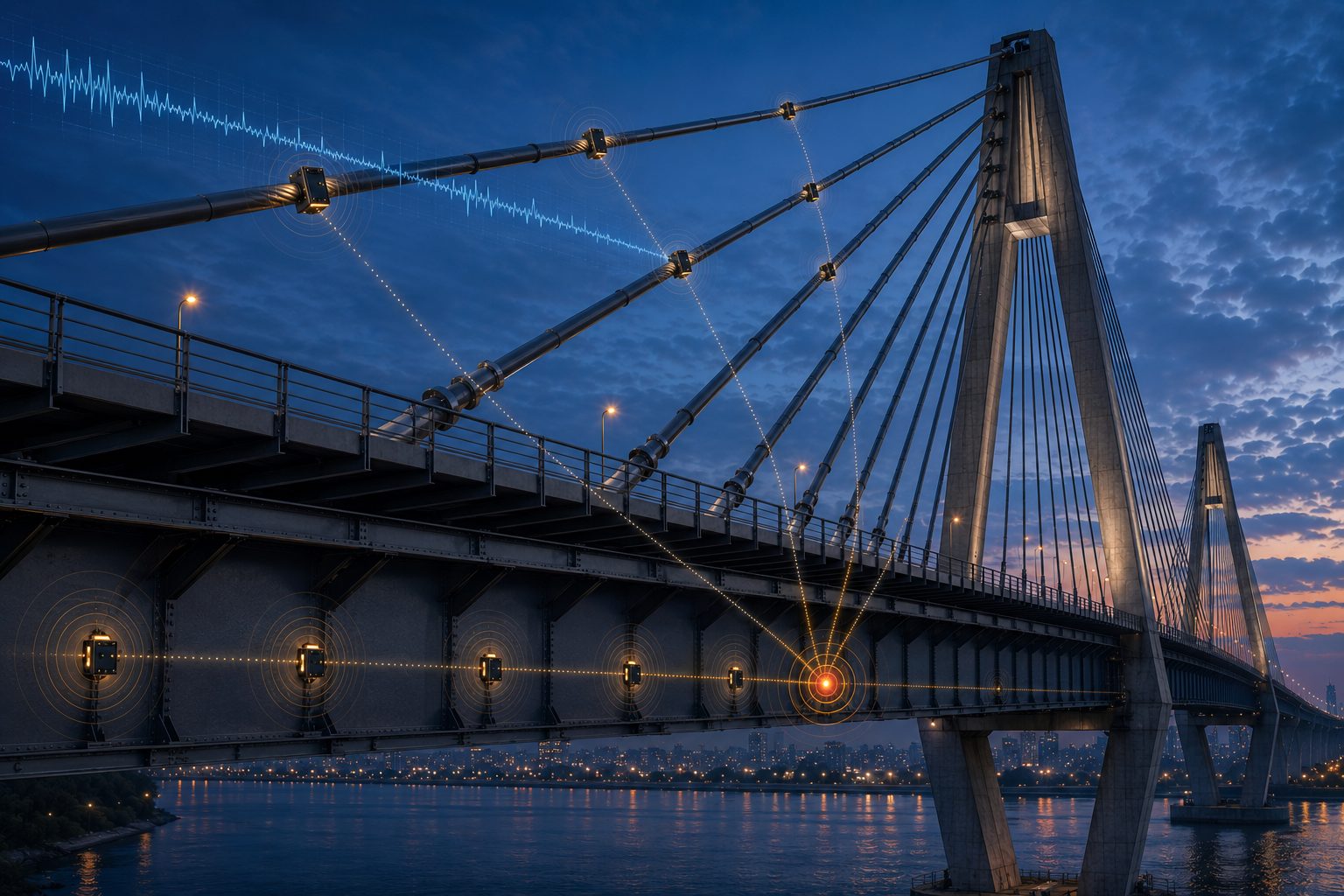
For large, long-span bridges, understanding how the structure behaves over time is a critical component of lifecycle asset management. Permanent Structural Health Monitoring systems allow owners to move beyond periodic inspections to continuous performance insight.
Ongoing monitoring of structural response, environmental conditions, and load effects provides real-time visibility into bridge behavior. This data supports informed maintenance planning and long-term performance evaluation well beyond initial construction.
Leonard P. Zakim Bunker Hill Bridge – Boston, MA (Bridges)
During deck repair work on this iconic cable-stayed bridge, maintaining safe operating conditions while keeping the bridge open to traffic was a primary concern. Repairs introduced temporary changes to load paths and stress distribution that required close observation.
Real-time monitoring of crack movement and structural response provided engineers with immediate feedback during construction activities. This visibility supported timely decisions and reinforced the role of monitoring during rehabilitation—not just during initial bridge construction.
Improving Safety and Efficiency in Challenging Environments
Iron Ore Mine – South Africa (Mining & Geostructural Imaging)
In mining environments, limited visibility into subsurface conditions can directly affect both safety and operational efficiency. Identifying voids and understanding rock mass characteristics are essential to planning excavation and blasting activities.
Geostructural imaging and analysis provided a clearer understanding of subsurface conditions, reducing uncertainty and investigation time. Improved insight supported safer working conditions and more efficient drill-and-blast operations.
Saudi Arabia Railway (SAR) – National Rail System (Embankments & Structures)
National-scale rail systems operate across vast and varied terrain, often under harsh environmental conditions. Safeguarding embankment stability and structural performance over time is critical to long-term reliability.
Performance monitoring and geostructural engineering across portions of the SAR network provided insight into how embankments and structures responded under operational and environmental loads. This information supports durable, resilient rail infrastructure at scale.
A Lifecycle Perspective on Infrastructure
Across these projects, a consistent theme emerges: when infrastructure is treated as a continuous lifecycle rather than a series of disconnected phases, teams gain clearer insight and greater confidence in their decisions.
For more than four decades, Geocomp has supported infrastructure teams across this lifecycle—from early planning through construction and into long-term operation. Rather than providing isolated measurements, Geocomp focuses on helping clients understand what their data means in the context of safety, performance, and long-term asset resilience.
The result is not just more information, but greater confidence in the decisions that shape infrastructure for decades to come.
Post by: Matthew Winslow, a Senior Business Development Associate at Geocomp, Inc., with more than 15 years of experience in scientific instrumentation, including a decade specializing in geotechnical instrumentation and monitoring. He works closely with infrastructure owners, engineers, and contractors to implement innovative monitoring solutions that improve safety and reduce project risk. Matthew brings a deep understanding of both technical systems and industry procurement processes, guiding clients through complex challenges with confidence. His work supports Geocomp’s mission to deliver data-driven insights for critical infrastructure projects.